
What Vets Wish Every Pet Owner Did at Home for Pet Dental Health
For most busy families, the idea of brushing a dog’s teeth every day might land somewhere between ambitious and laughable, depending on the day. But dental disease is one of the most common, most painful, and most preventable health issues in dogs and cats, and the gap between professional cleanings matters a lot when it comes to how much disease develops in between. Daily toothbrushing is the gold standard, but it is not the only option, and for dogs and cats who tolerate it poorly, enzymatic gels, dental wipes, and specific water additives can all contribute meaningfully to a realistic home care routine.
Mid-Valley Veterinary Hospital serves dogs, cats, and the full spectrum of animals in the rural communities around Chico, and our dental care services reflect a practical, honest approach to what actually works in real households. We are happy to walk you through at-home technique and help identify which products are worth using. Contact us to schedule a dental evaluation and come away with a home care plan built for a real schedule.
Why Dental Disease Deserves More Than an Annual Check
Most people understand that pets need dental cleanings, but fewer realize how quickly the situation can deteriorate between visits when nothing is happening at home. Plaque, a soft bacterial film, forms on tooth surfaces within hours of cleaning. Within days it begins to mineralize into tartar, which irritates gum tissue and sets off the progression toward periodontal disease: gingivitis, bone loss, tooth root infection, and eventual extraction.
What makes this worth consistent effort is the systemic dimension. The bacteria driving periodontal disease don’t stay confined to the mouth. They can enter the bloodstream and affect the kidneys, liver, and heart over time. Any home care that slows plaque accumulation between professional dental cleanings is reducing that downstream risk, not just keeping teeth looking cleaner. Our wellness and preventative program incorporates dental evaluation at every exam so early changes are caught before they require significant intervention.
Toothbrushing: Still the Best Option When It Works
Why Physical Scrubbing Outperforms Everything Else
Brushing works because it mechanically disrupts bacterial biofilm before it can harden into tartar. No gel, rinse, or chew replicates that direct contact, which is why veterinary dental guidelines consistently rank brushing at the top. Daily brushing is ideal, but every-other-day brushing still provides real benefit. If full brushing isn’t realistic on a given day, even a partial pass along the outer surfaces is better than skipping entirely.
Building Up to a Brush Gradually
Pets who have never had their mouths handled regularly need a patient introduction, and that investment pays off in years of easier home care. A sensible approach:
- Handle the muzzleand gently lift the lips daily for a few days, rewarding calm behavior after each session.
- Run a fingeralong the outer tooth surfaces and gumline until the sensation feels routine.
- Introduce a small amountof pet-safe enzymatic toothpaste on the fingertip, letting them taste it.
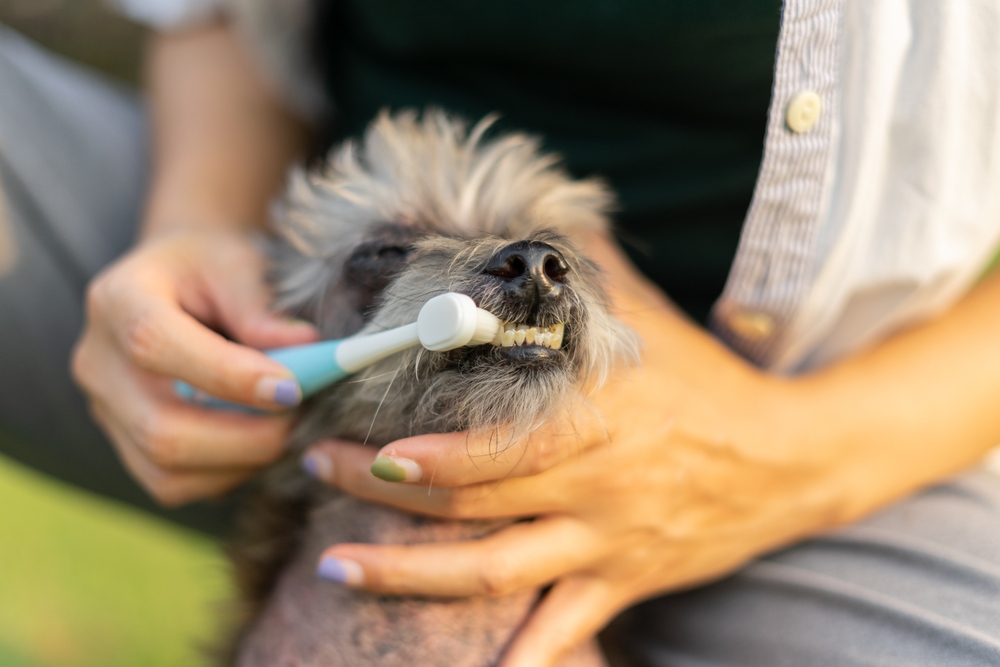
- Move to a soft-bristled toothbrushor finger brush at the front teeth only.
- Gradually extend the sessiontoward the back teeth over days or weeks.
Cooperative care techniques that emphasize positive reinforcement and voluntary participation build far better long-term tolerance than simply restraining a pet and getting through it.
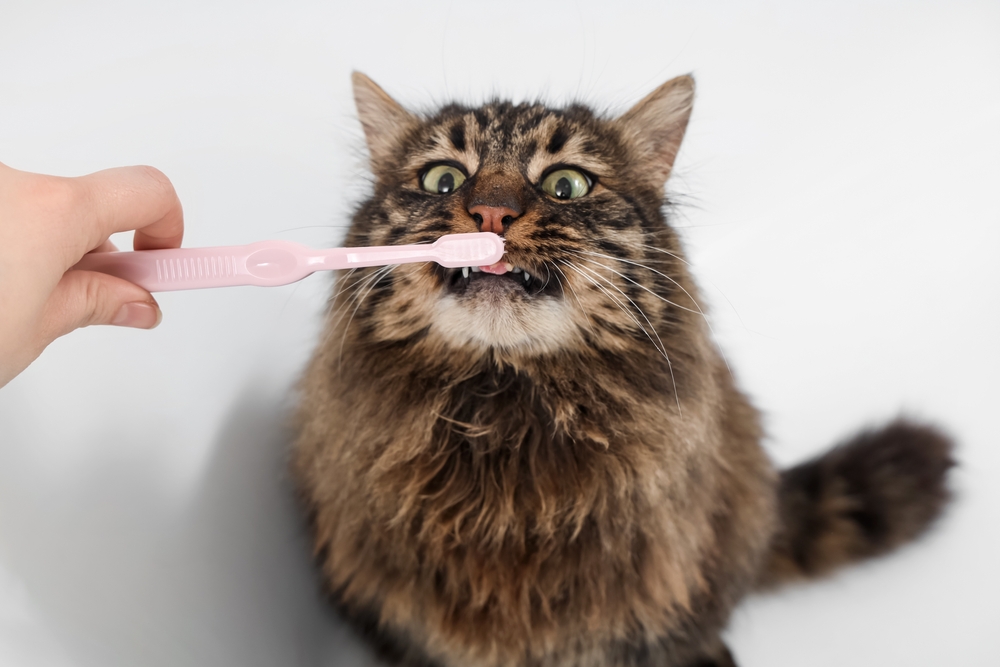
For brushing dog teeth, a 45-degree angle at the gumline and short circular strokes work well, with particular attention to the upper back molars where tartar accumulates fastest. Working one side at a time keeps the process manageable. For brushing cat teeth, smaller brushes with very light pressure and shorter sessions are generally more successful than attempting the same approach used for dogs. Cats are often more cooperative when they feel secure rather than held in place.
Never use human toothpaste. Fluoride is toxic to pets, and xylitol, which appears in many human dental products, can be fatal. Our pharmacy carries C.E.T. Enzymatic Toothpaste in pet-friendly flavors, along with a full range of toothpaste and toothbrushes to help you find the right combination for your pet’s size and tolerance.
When Brushing Isn’t Going to Happen
Dental Wipes as a Practical Alternative
For pets who resist brushes, dental wipes or gauze wrapped around a finger provide friction-based cleaning on accessible surfaces. They work best on the outer faces of the front teeth and canines and are less effective at reaching gumlines and back molars, but used consistently and paired with an enzymatic product, they deliver real benefit. Some pets and households end up on wipes permanently, and that is a legitimate outcome rather than a failure.
Vetradent Dental Wipes are a practical option for dogs and cats who need a brush alternative, and we can walk you through technique at your next dental visit.
Enzymatic Gels, Powders, and Sprays: Chemical Action Without Mechanical Work
Enzymatic products break down bacterial biofilm chemically using enzyme systems that target plaque at the molecular level. They can be applied with a brush, a finger, spray, on food, or in some formulations simply allowed to coat the teeth after the pet licks the product. Most require no rinsing. They provide meaningful benefit even without brushing and significantly enhance the effectiveness of any brushing or wiping that does occur.
Perio Support Dental Care Powder is an easy-to-use option for pets who will not tolerate direct application, mixed into food to support oral health passively. Applied enzymatic products work best along the gumline and outer tooth surfaces where bacterial accumulation is highest.
Water Additives: The Lowest-Effort Option
Water additives deliver antimicrobial or enzymatic ingredients with every sip, making them the most hands-off option available. They cannot remove existing tartar or match the effectiveness of direct application methods, but for pets who resist everything else, they add a meaningful layer of protection. Introduce them gradually at a low concentration to avoid any palatability issues that would cause the pet to drink less.
Vetradent Water Additive is a simple daily option that fits into any routine without adding handling time. Ask us whether it’s appropriate given your pet’s current oral health status before starting.
The full range of dog dental products and cat dental products in our pharmacy covers brushing, wipes, gels, rinses, and more, so whatever approach ends up working, the supplies are available in one place.
Dental Diets and Chews as Supporting Tools
Dental diets are formulated with a larger kibble shape that requires teeth to penetrate before the food crumbles, producing mild abrasive cleaning with each bite. Some formulations also bind calcium to slow tartar mineralization. Like all home care tools, they extend the interval between professional cleanings without replacing them.
Chews provide plaque removal through sustained chewing contact, and selecting the right ones matters. Dangerous chew items including antlers, hooves, and hard nylon products are a leading cause of fractured teeth, even though they often advertise themselves as “dental care products.” The rule of thumb: if pressing a thumbnail into the chew doesn’t leave a dent, it is too hard. Safe chew toys flex and give under pressure. Well-designed dental chew toys with textured surfaces that reach between teeth contribute genuine plaque removal when matched to the pet’s size and chewing style. Our pharmacy also carries a selection of dog dental chews and treats for owners looking for veterinary-vetted options.
The VOHC Seal: A Reliable Filter in a Crowded Market
Pet dental products range from genuinely effective to essentially inert, and the label claims don’t always distinguish between the two. The Veterinary Oral Health Council (VOHC) is an independent body that reviews clinical trial data submitted by manufacturers and grants a seal only to products that demonstrate measurable plaque or tartar reduction in controlled studies. VOHC-accepted products span chews, water additives, diets, wipes, and topical gels for both dogs and cats.
A product without the seal isn’t automatically ineffective, but a product with it has been tested and shown to work. When navigating a store shelf or an online catalog, the VOHC seal is the most practical shortcut available. We are happy to discuss which accepted products make the most sense for your individual pet.
What Professional Cleanings Still Need to Do
Home care cannot remove tartar that has already mineralized, and it cannot address subgingival disease, the infection and bone loss occurring below the gumline that determines long-term tooth and jaw health. Professional cleanings under anesthesia allow for thorough scaling of all tooth surfaces, probing of pocket depths, full-mouth dental radiographs to reveal root and bone pathology, and polishing to slow plaque re-adhesion.
Anesthesia-free dentals, however appealing they sound, address only the visible surface while leaving subgingival disease untouched. The appearance improves; the actual disease does not. Our dental procedures include full anesthesia with comprehensive vitals monitoring, IV fluids, oral nerve blocks, and Class 4 laser therapy to support healing of gum tissue following extractions or deep cleaning. Good home care earns longer intervals between procedures, not a pass on having them.
Making the Routine Stick
The best home dental care routine is the one that actually gets done. Pairing it with something that already happens daily, bedtime, the morning feeding, or coming in from an evening walk, dramatically increases how consistently it happens. Keep supplies accessible rather than stored away. Involve everyone in the household so the routine holds across different schedules.
Practical troubleshooting for common sticking points:
- Resistance to the brush:back up to a finger or wipes and rebuild tolerance before reintroducing the brush
- Limited time:even 30 seconds of enzymatic gel applied to the gumline daily is producing benefit
- Multi-pet household:each pet needs its own supplies and ideally its own dental care moment to avoid competition
- Make a backup plan: On days you can’t brush, give a dental chew. Use a water additive every other day. Add a dental powder just to dinners. Anything is better than nothing.
Progress in home dental care is incremental. Fresher breath, firmer and pinker gums, and less visible tartar between cleanings are all signs the routine is working. We are available to troubleshoot, demonstrate technique, and help identify the right combination of products for each individual pet at your next dental care visit.
Your Partner in Lifelong Oral Health
Every bit of consistent home care makes a measurable difference in how quickly dental disease develops and how often professional intervention becomes necessary. We are here to help you build a routine that is realistic for your household, your pet’s temperament, and the rhythms of real life. Contact us to schedule a dental exam and leave with a home care plan that has a genuine chance of becoming a daily habit.




Leave A Comment