
Many of the toys, chews, and collars sold at pet stores carry real injury risks that the packaging never mentions. Rope toys, real bones, retractable leashes, and prong collars turn up in our exam rooms again and again, linked to fractured teeth, gastrointestinal obstructions, tracheal injuries, and cuts. Some injuries happen in a single moment, and others, like a cracked tooth or a strained neck, build over days before you notice anything is wrong. Knowing which products carry the most risk matters as much as knowing what to reach for instead.
At Mid-Valley Veterinary Hospital in Orland, we work with dogs and their families every day, and we see how fast a well-meant purchase can turn into an urgent visit. Our wellness and preventive care in Orland includes head-to-tail exams that catch the early signs of gear-related trouble before they become serious. If your dog is already showing signs of a problem, or you simply want to talk through safer choices first, reach out to our team and we will help you sort through it.
Important Information About Dog Gear
- Many common products, including rope toys, real bones, retractable leashes, and prong collars, cause injuries we treat every week.
- A hard chew that fractures a tooth usually leads to an extraction, so the thumbnail test is worth doing before you buy.
- Aversive training tools like prong collars, choke chains, and shock collars carry physical and behavioral risks, while reward-based training is safer and works better.
- The right gear depends on the individual dog, and a quick conversation about size, chewing style, and behavior gets you to safer choices.
How Does Your Dog’s Body Language Point to Safer Gear?
Your dog tells you whether a piece of gear fits and feels right through posture, facial expression, and movement, often well before a sore develops. Learning to read those signals lets you swap an uncomfortable collar or harness early, and it keeps walks from becoming something your dog quietly dreads.
Subtle stress signals to watch for as gear goes on:
- Lip licking, yawning, or whale eye (the whites of the eye showing)
- A stiff, frozen posture
- Avoidance, hiding, or moving away
- A tucked or unnaturally low tail
- Ears pinned back
Physical signs that equipment is causing discomfort:
- Pawing at a collar, harness, or chew
- Coughing or hacking on walks
- Skin redness or hair loss where gear sits
- Limping after walks
- Flinching when touched where equipment rests
Reading canine body language and the signals your dog sends is a learnable skill, and our team can assess how your dog responds to specific gear during a wellness visit.
Why Do Veterinarians Recommend Reward-Based Training?
Reward-based training works by rewarding the behavior you want instead of punishing what you do not, which builds trust, lowers stress, and creates habits that last, all without tools that can injure the throat, neck, or spine. For most dogs it is both the safer and the more effective path.
Positive reinforcement training is easiest to see in a common problem like leash pulling:
- Aversive approach: a prong collar bites into the throat when the dog pulls, suppressing the pull through pain without teaching anything, and the stress that drove the pulling is never addressed.
- Reward-based approach: the dog earns small treats for a loose leash and learns that slack is the rewarding choice, so the behavior sticks without ongoing correction.
For tougher cases like leash reactivity, where dogs are reacting to a trigger like another pet or person out of fear or uncertainty, structured techniques such as the engage-disengage game teach a dog to notice a trigger calmly and look back at you. This reshapes the feeling from fear to positivity over time, rather than masking it. Using pain or negative reinforcement to suppress a behavior that is fear-based often results in worsening behavior- adding more negativity to an already scary situation doesn’t help anyone.
Which Training Devices Should You Avoid?
Avoid the devices that rely on pain or pressure: prong collars, choke chains, and shock collars. They’re commonly called “training collars”, giving the impression that they actually teach your dog something valuable. Each can suppress a behavior or seem convenient in the moment, but they carry real risks to the neck, the skin, and your dog’s emotional state, and gentler tools do the job better.
Prong Collars and Choke Chains
These tighten around the neck to suppress pulling through discomfort rather than teaching anything. The physical risks include:
- Tracheal damage: a sudden lunge into a tightening collar can bruise or injure the windpipe.
- Neck and spine injury: the force lands on delicate structures.
- Skin punctures: the prongs can break the skin.
- Thyroid pressure: repeated tightening sits right over the gland.
Prong collars are especially risky for dogs with tracheal collapse or disc disease, and injuries can be serious.
Shock Collars and Aversive Tools
Aversive training methods, including shock collars sold as e-collars or stimulation collars, tend to raise stress and worsen the very behaviors they target. The risks run physical and behavioral:
- Burns and skin damage: the contact points sit against the neck.
- Deeper fear: the dog dreads whatever preceded the shock, like other dogs or strangers.
- Rising aggression: the dog often ties the pain to the environment rather than to their own behavior.
- Generalized anxiety: the worry spreads beyond the original trigger.
Retractable Leash Hazards
Retractable leashes carry several specific problems:
- They reward pulling: the leash extends right when the dog pulls.
- They reduce control: your dog can be sixteen feet away when something happens.
- The thin cord injures: retractable-leash injuries to dogs and people include cuts and friction burns.
- Breaking cords: a lunge can from a large dog can snap a thin cord.
What Walking Equipment Do Veterinarians Recommend?
Gear that keeps pressure off the throat and matches your dog’s build, paired with a fixed-length leash. For most dogs that means a well-fitted harness rather than the collar taking the strain, with the specific choice depending on how hard your dog pulls and the shape of their head and neck.
Collars and Harnesses
| Walking gear | Best for | How it helps |
| Front-clip harness | Dogs that pull | Redirects forward motion from the chest |
| Head halter | Strong pullers | Gentle head control, with a patient introduction |
| Back-clip harness | Easy walkers | Comfortable, with no throat pressure |
| Martingale collar | Narrow-headed dogs | Stops backing out without choking when fitted properly |
| Flat collar | ID tags and everyday wear | Fine for tags, not the pull point for a puller |
Choosing the right collar and walking gear requires evaluating your dog’s behavior and body shape. We can talk through gear choice and fit during a wellness visit.
Standard Leashes and Long Lines
A fixed four-to-six-foot leash gives the best balance of freedom and control for everyday walks, keeping your dog close enough to manage while still comfortable. For recall practice in open space, a long line of fifteen to thirty feet is the safer alternative to a retractable, with no retractor to fail and no reward for pulling.
Which Toys Are Most Likely to Injure Your Dog?
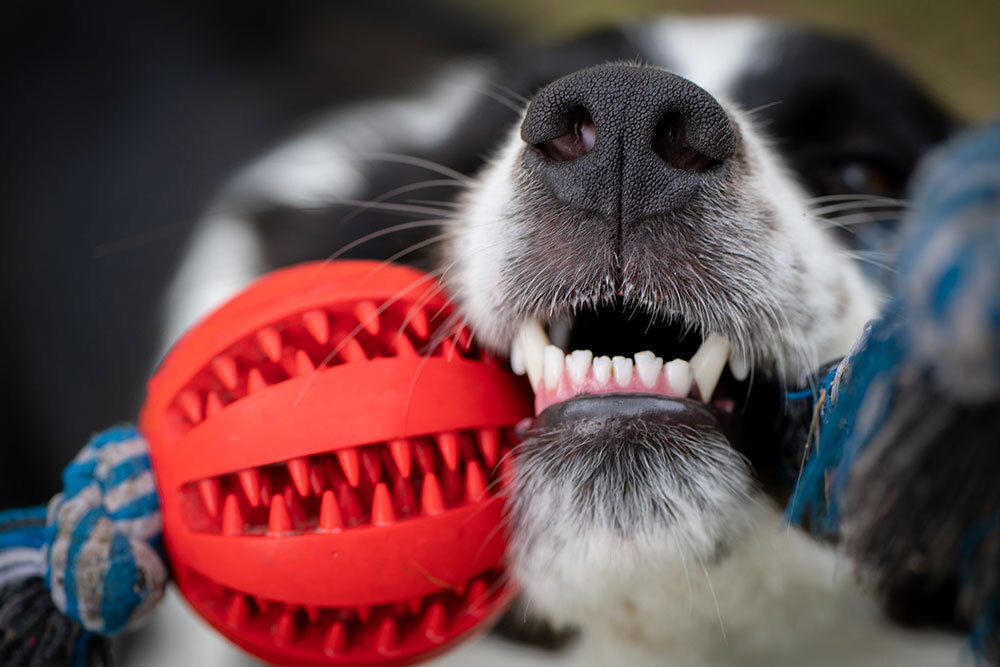
The toys that cause the most trouble are the ones that break into swallowable pieces or are hard enough to crack teeth. Swallowed fragments cause gastrointestinal foreign bodies that range from mild upset to a life-threatening blockage needing surgery, so a toy’s size and durability matter as much as how fun it looks.
The riskiest categories:
- Rope toys: chewed-off strands can bunch into a linear foreign body that cuts the intestine, a real danger for hard chewers.
- Squeaker toys: an exposed squeaker turns into a choking hazard.
- Undersized balls and toys: anything smaller than your dog’s mouth can go straight down.
- Hard plastic toys: rigid enough to fracture teeth, especially in determined chewers.
- Stuffed toys: swallowed filling can pack together and obstruct the gut.
- Abrasive toys: some rough surfaces, like tennis balls, wear enamel down to the dentin.
A few habits prevent most toy emergencies:
- Replace worn toys before they start to fragment
- Supervise any new toy until you know how your dog plays with it
- Rotate the toy bin instead of leaving everything out at once
- Size up, because anything small enough to swallow is small enough to be a problem
Which Chews and Treats Pose the Biggest Risks?
Chewing is healthy, but many of the most popular chews are hard enough to fracture teeth or dense enough to block the gut. The large upper chewing tooth, the carnassial, is the one that breaks most often, and a fracture that reaches the pulp almost always means the tooth has to be removed. Even if a tooth doesn’t fracture, the wear that accumulates over time from chewing hard objects can expose the pulp of the tooth, setting you up for a tooth root abscess.
The worst offenders for teeth:
- Real bones, raw or cooked: a leading cause of a fractured carnassial tooth.
- Rawhide: softens into a dense, hard-to-digest wad that can lodge in the esophagus or intestine.
- Antlers and hooves: notorious for slab fractures of the premolars, often spotted only when your dog starts avoiding that side.
- Hard nylon bones: can splinter into sharp points that scratch the gut.
- Any chew worn to a nub: small enough to swallow whole and choke on.
Warning signs of a chew-related problem:
- A discolored, broken, or crooked tooth
- Heavy wear on the tips of teeth, especially if you can see a dark dot at the end of the tooth
- Bleeding gums or refusing to eat
- Heavy drooling or pawing at the face
- Breath that turns bad or noticeably worse
- Vomiting or a change in appetite
Our dental care includes the radiography to find fractures below the gumline and the surgical capability to extract a damaged tooth, and our class 4 laser therapy supports healing afterward.
What Are Safer Toy and Chew Alternatives?
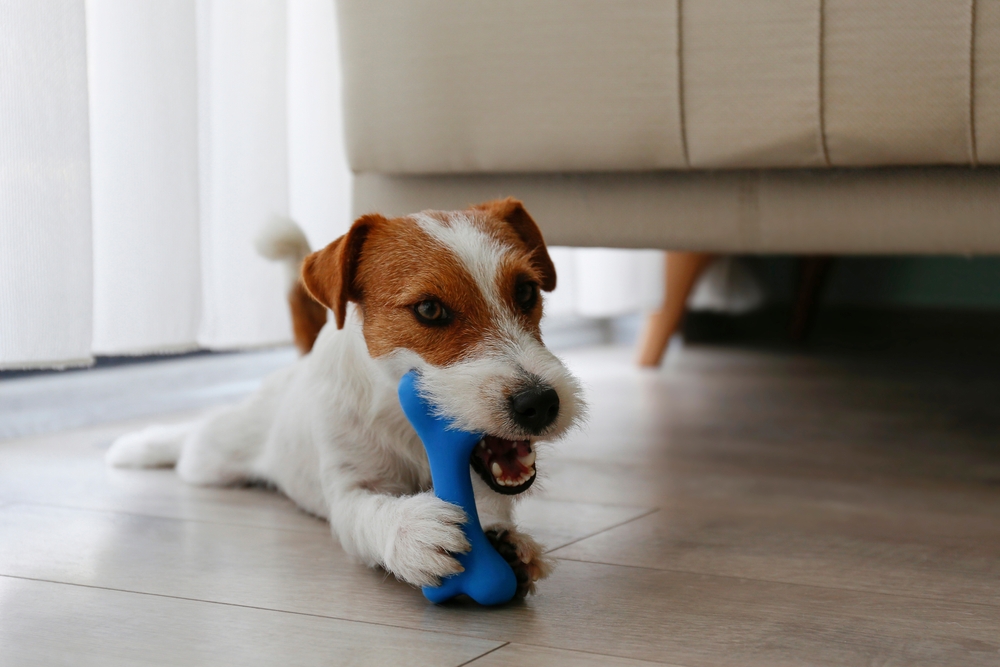
Plenty of safer options give your dog the chewing and enrichment they need without the risk. The guiding rule is the thumbnail test: if you cannot dent it with a thumbnail, it is too hard for your dog’s teeth, and there are good chews and toys that pass it.
Safer chews to reach for:
- VOHC-accepted dental chews: the Veterinary Oral Health Council seal marks a proven dental benefit.
- Edible ‘natural’ chews: collagen-based and rawhide alternatives are safer options than real rawhide or bones
Safer toys to reach for:
- Durable rubber toys: stuff a Kong with food for chewing that lasts.
- Puzzle feeders: engage the brain without heavy chewing.
- Snuffle mats: enrichment through sniffing.
- Treat-dispensing toys: sized for your dog.
When Is Destructive Chewing a Medical Problem?
Gear and toys alone rarely fix a behavior problem, and sometimes destructive chewing is a sign of something physical. A dog who suddenly chews everything may be in pain, anxious, or dealing with a medical change, so a sudden shift is worth a closer look before you treat it as simple mischief.
Possible contributors include:
- Pain: some dogs chew hard for relief, including from dental pain.
- Cognitive change: older dogs can develop new, restless habits.
- Anxiety: a change at home can surface as chewing.
- Endocrine or metabolic disease: these can shift appetite and behavior.
A wellness visit can rule out the medical contributors before we treat a chewing problem as purely behavioral.
Frequently Asked Questions About Dog Gear
What’s the Safest Chew for a Heavy Chewer?
For a determined chewer, the safest picks are VOHC-accepted dental chews, food-stuffed rubber toys, and softer rubber chews that pass the thumbnail test. Steer clear of antlers, hooves, bones, hard nylon, and rawhide. Supervise any new chew, especially the first few times you offer it.
Is It Ever Appropriate to Use a Prong Collar?
Most veterinary professionals advise against prong collars in any situation. The injury risk is real, and a front-clip harness, a head halter, and reward-based training reach the same goals without it. If you are managing a strong puller or a reactive dog, we can talk through safer options that fit your situation.
My Dog Chews Toys to Pieces. Is Anything Truly Indestructible?
Against a determined chewer, no toy is truly indestructible, so the goal is durable rather than unbreakable. Choose appropriately tough toys, supervise play, and replace them before they break down. Many dogs do best with a food-stuffed Kong that occupies them productively instead of a toy that becomes a project to destroy.
What If My Dog Already Swallowed a Piece of a Toy or Chew?
Call us or come in right away. Small pieces sometimes pass, but others cause an obstruction within hours. Vomiting, a tender belly, refusing food, low energy, or any change after a known swallow all warrant prompt evaluation. Do not wait it out if your dog seems unwell.
Choosing Gear That Keeps Your Dog Safe
Informed choices protect your dog’s health, support good behavior, and head off the painful, costly emergencies we see every week. The right gear, toys, and chews depend on your dog’s size, chewing style, and history, which is exactly the kind of thing we talk through at a wellness visit.
If you would like personalized guidance on equipment, toys, or chews, or your dog is showing any sign of a gear-related injury, contact us and we will help you sort it out.





Leave A Comment